Slot Intelligence Series / Deep Dive
Perceived Progression
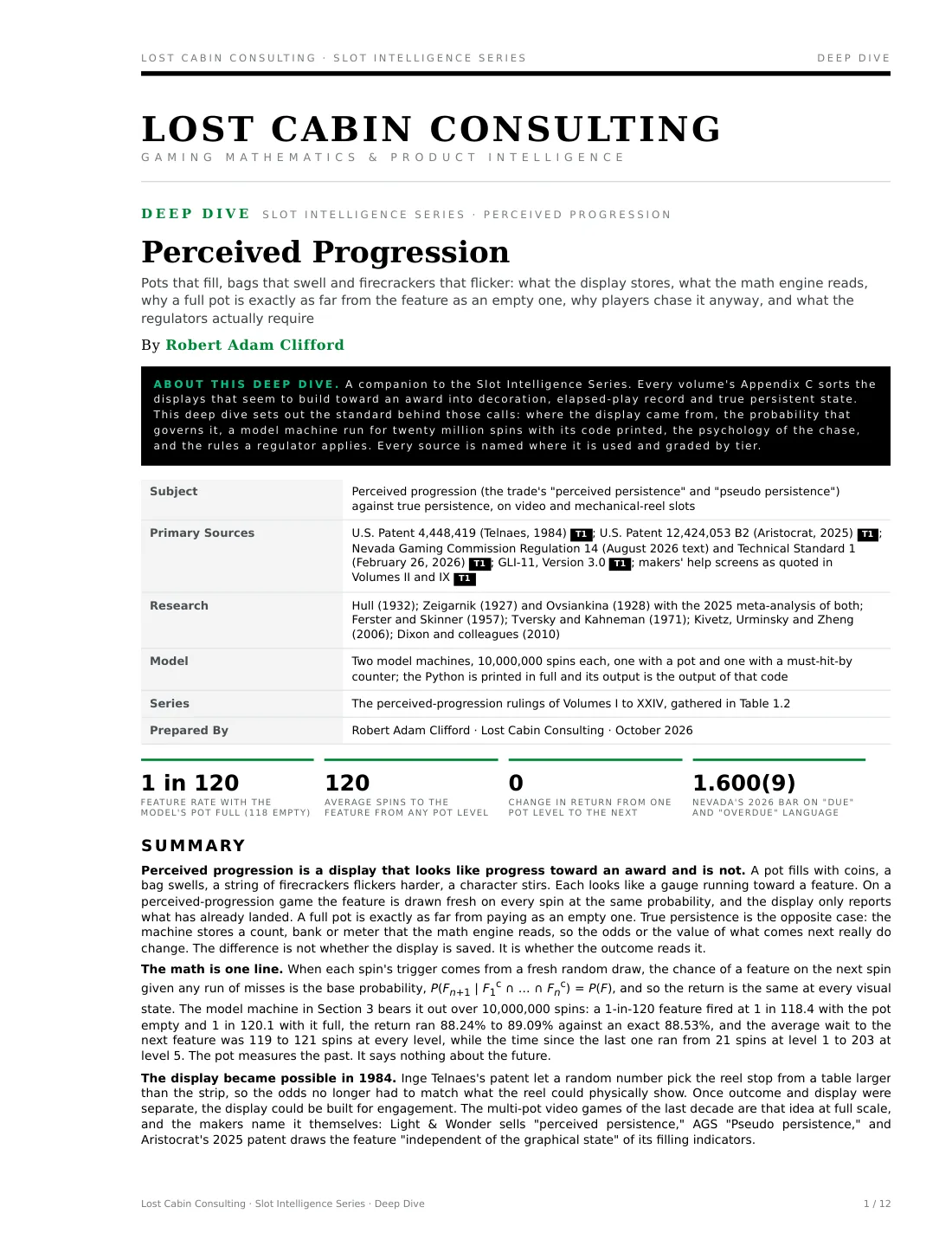
Pots that fill, bags that swell and firecrackers that flicker: what the display stores, what the math engine reads, why a full pot is exactly as far from the feature as an empty one, why players chase it anyway, and what the regulators actually require.
- Spins simulated
- 20M
- Feature rate, empty pot
- 1 in 118.4
- Feature rate, full pot
- 1 in 120.1
- Volumes ruled on
- 24
What the deep dive is
A free companion to the Slot Intelligence Series, alongside the Payline Layout Key. Every volume's Appendix C sorts the displays that seem to build toward an award into three classes: decoration, an elapsed-play record, and true persistent state. This deep dive sets out the standard behind those calls, with every source named where it is used and graded by tier.
Perceived progression is a display that looks like progress toward an award and is not. On a perceived-progression game the feature is drawn fresh on every spin at the same probability, and the pot only reports what has already landed. True persistence is the opposite case: the machine stores a count, bank or meter that the math engine reads, so the odds or the value of what comes next really do change. The difference is not whether the display is saved. It is whether the outcome reads it.
What it covers
- Definition: perceived progression (the trade's "perceived persistence" and "pseudo persistence") against true persistence, side by side, with the makers' own words for it from Light & Wonder, AGS and Aristocrat's 2025 patent.
- History: how Inge Telnaes's 1984 virtual-reel patent separated the outcome from the display, the 1989 near-miss ruling, and the multi-pot video games that followed.
- The math: the one-line proof that the chance of a feature on the next spin is the same at every pot level, why the return cannot depend on the visual state, and two model machines run for 10,000,000 spins each, with the Python printed in full. The pot machine's return ran 88.24% to 89.09% at every level against an exact 88.53%; a must-hit-by counter ran from 1 in 208.5 early to 1 in 30.3 late.
- Psychology: the goal gradient, the Zeigarnik and Ovsiankina effects (and the 2025 meta-analysis that split them), random-ratio schedules, the gambler's fallacy, sunk cost, losses disguised as wins and near misses, each graded by what the research actually shows.
- Regulation: what Nevada's Regulation 14, Technical Standard 1 and GLI-11 require, what they do not, and Nevada's 2026 bar on "Due," "Overdue" and "Ready to Hit" language.
- Field method: six steps for reading a progression display on the floor, and a table of what the next spin is worth on a pot against a must-hit-by counter.
The series' rulings
Each volume's Appendix C classes the game's progress displays on the record. The deep dive gathers them:
- Decoration: Big Hot Flaming Pots' three pots ("for presentation only"), the Quick Hit Ultimate Fire Link pot and Huff N' Puff Hard Hat Edition's hat, by the maker's own label.
- Elapsed-play record: Dancing Drums' coin pot, the archetype ("no effect on triggering the Jackpot Bonus"), Rakin' Bacon's golden pig and Spooky Link's gem pots.
- True persistent state: Regal Riches' wild banks (must hit by 75, 100 and 125), the Phoenix Link counter, Lightning 10 Year Storm's "MUST BE WON BEFORE 1888" meter, Magic Treasures Gold' numbered Money Ball pot and Ultimate Fire Link's Cash Falls held reels.
- Nothing that fills: Dragon Link and Lightning Link, the null case.
The Keno volume applies the same rule to the "overdue" number. The full table, Volumes I to XXIV, is in the PDF.
Questions
Does a full pot on a slot mean the bonus is due?
No, not on a perceived-progression game. The feature is drawn fresh on every spin at the same chance. In the deep dive's 10,000,000-spin model, a 1-in-120 feature fired at 1 in 118.4 with the pot empty and 1 in 120.1 with it full. A full pot only shows that the last feature was a long time ago.
What is the difference between perceived progression and true persistence?
Perceived progression is a display that looks like progress while the odds never change. True persistence is a stored count, bank or meter that the game's math reads, so the chance or the value of the next feature really does change, as with a must-hit-by counter. The test is not whether the display is saved, but whether the outcome reads it.
How can I tell which kind a slot machine has?
Read the help screens. "For presentation only," "no effect on triggering" or "a chance of being triggered on every spin" mean perceived progression. "Must be won before," "must hit by," "increases the chance" or a stated threshold mean true persistent state.
Do regulators require a disclaimer on slot pots?
No. Nevada's Regulation 14 and GLI-11 require accurate, non-misleading rules and help screens, and GLI-11 requires a true persistence game to describe its thresholds. Since February 26, 2026, Nevada's Technical Standard 1.600(9) also bars language such as "Due," "Overdue" and "Ready to Hit." Disclaimers printed on pots are the makers' own words.
Is a machine left with a full pot worth playing?
Not on perceived progression: the next spin has the same chance however full the pot is. Only bounded, visible true persistence carries value to the next player, such as a must-hit-by wild bank near its ceiling on Regal Riches or a Phoenix counter near 1,888 on Phoenix Link.
Independent research by Lost Cabin Consulting LLC, not published, endorsed or reviewed by any game maker, laboratory or regulator; game names belong to their owners. The model machines and the virtual reel in the deep dive are teaching models, not any maker's game. The help screen of the machine in front of you governs that machine. Gambling carries real risk of loss, and nothing here promises a win. Play only where it is legal and you are of age. See the disclaimer.
For the features that change the wager itself, see the free companion Odd Mechanics: bonus buys, gambles, video poker Double Up and wager savers.
Practice the table games free in the casino simulators, or see every volume.