Home › Oil and Gas Services › Torque and Drag Modeling
Oil & Gas · Engineering service
Torque and Drag Modeling
Know the loads before the string goes in the hole. We model pick-up, slack-off, rotating torque, buckling, lockup and fatigue on your actual survey and hand back a one-page answer the rig can run with. Powered by Vectis Downhole Intelligence, our own well engineering software suite.
What we model
- Jobs: plug drill-outs, cleanouts, TCP gun runs, workover and completion strings, tapered work strings.
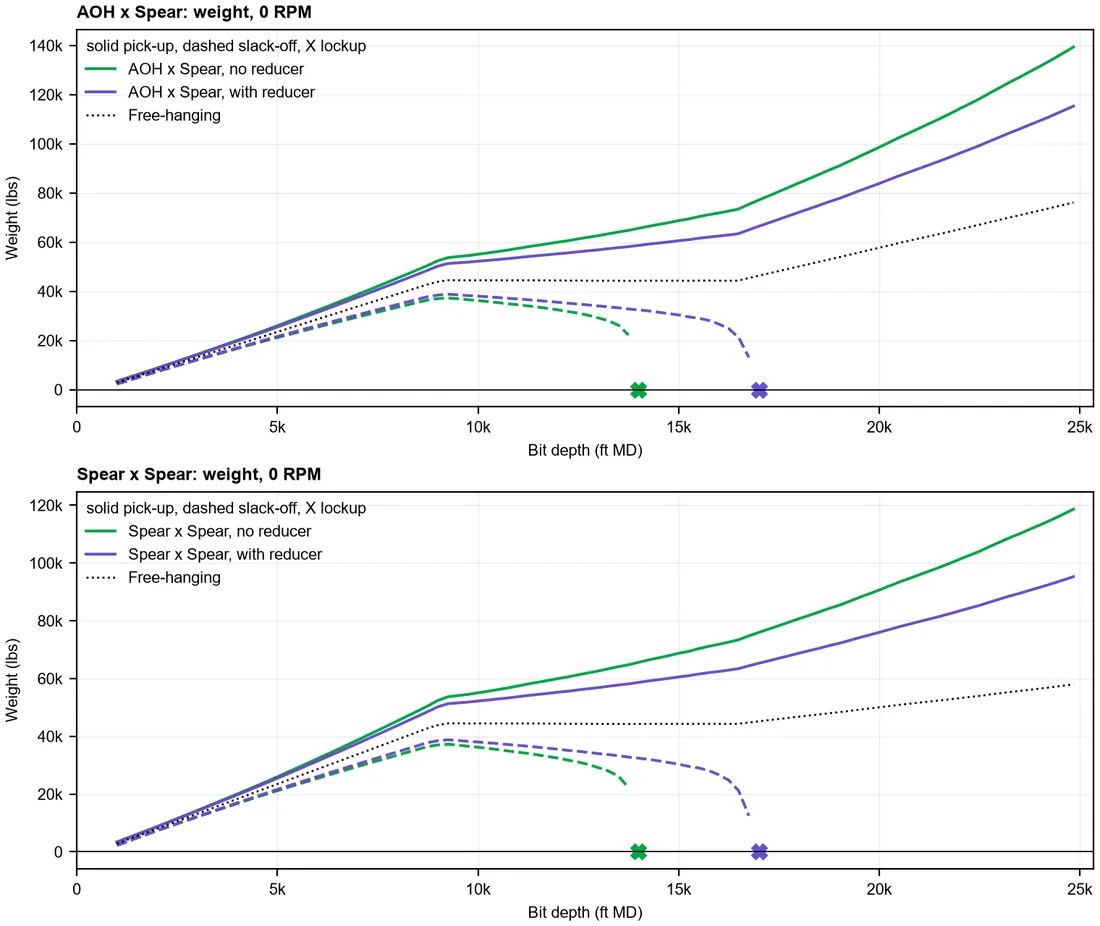
- Hookload: pick-up, slack-off, free-hanging and rotating off bottom at 0, 45 and 90 RPM, every 10 ft along the survey.
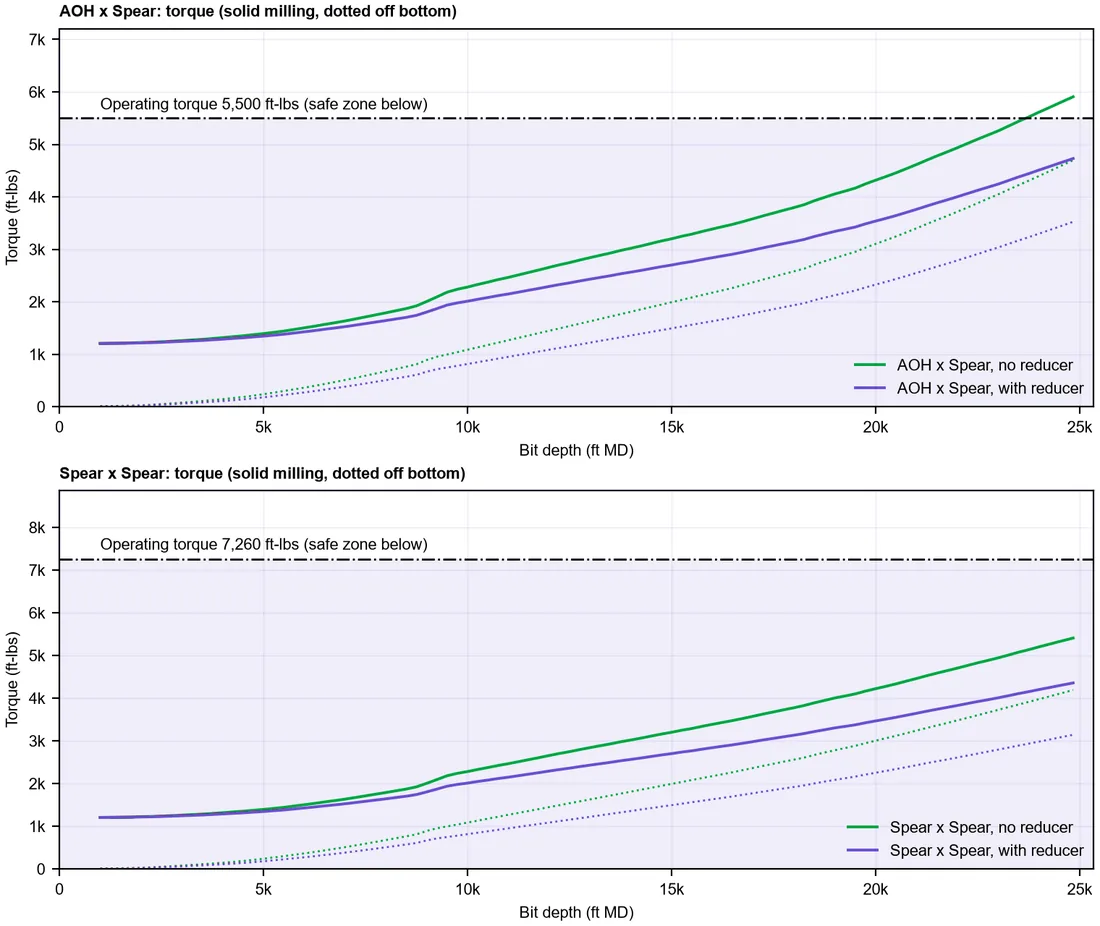
- Torque: surface and downhole torque at the tool-joint OD, checked against the string's operating torque (80% of the midpoint between make-up torque and max rotational torque). Make-up and rotational ratings are never mixed up.
- Friction: with and without T&D reducer, side by side.
- Drill-outs and cleanouts: wellhead pressure and stripper force at surface, motor reactive torque, weight on mill, every plug to the toe.
- Buckling and lockup: Dawson-Paslay sinusoidal, curved-hole buckling through the build and turns, Lubinski vertical above the KOP, Mitchell helical contact force, slide-in lockup depth and the max weight you can actually put on the mill.
- Fatigue: Lubinski dogleg bending against the API RP7G line at every 10 ft while rotating.
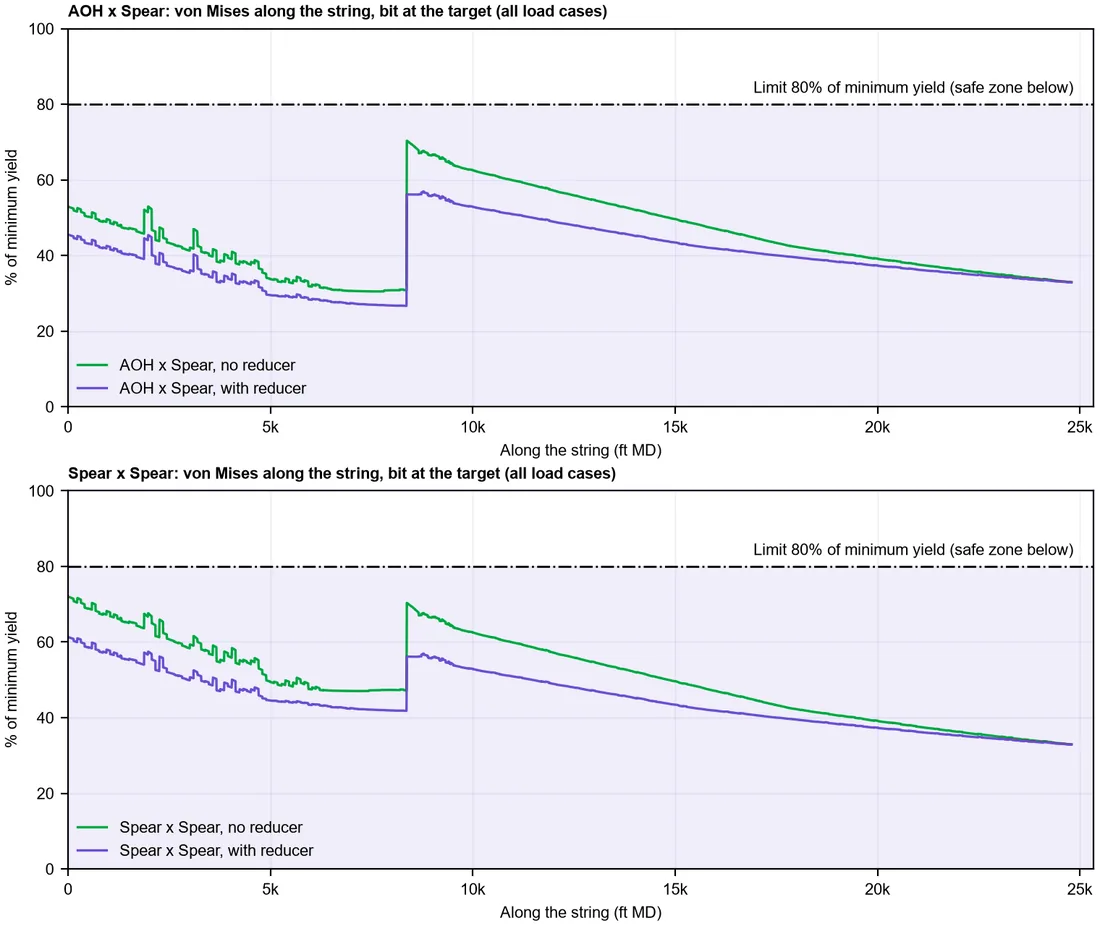
- Stress: von Mises equivalent stress on worn (premium-class) pipe at every 10 ft in every load case, from tension, dogleg and buckling bending, torsion and pump pressure, plus a combined tension and torque check on each connection, all held to 80% of rating.
- Soft or stiff string: the soft-string answer, or a stiff-string run through the BHA and the stiff window above it, where pipe stiffness changes the side force.
- Friction from your own readings: pick-up, slack-off and torque readings from the rig fit the friction factors for the next run on the pad.
- Stuck pipe: free point from stretch, back-off make-up and cut depth, and buoyancy or flotation for long laterals.
- Coiled tubing, wireline and snubbing: coiled tubing forces, reach and lockup with the limit curve and reel fatigue, wireline and slickline tension and reach, and snubbing force with the balance point.
- Tension: against premium class, with overpull available to 80% of premium class at the weakest point.
- Two string designs per well: compare two work strings on the same page, for example 2-7/8" over 2-3/8" in two different connections, and pick the one that gets the job done.
- 3-D well paths: single well or full pad, built from the surveys, with an interactive 3-D viewer attached to every report.
- Casing and cement in 3-D: a layered wellbore from the casing program and the cement bond log, with bond index along the depth, channels, liner-top hardware and a cross-section at any depth.
- Wireline logs in 3-D: LAS, DLIS or CSV logs tied to the survey depth. The caliper sets the true hole size, the CBL colors the cement, and gamma ray, density, neutron or resistivity color a ring around the hole.
Vectis Downhole Intelligence is our own code built on published industry methods (Johancsik soft-string, minimum-curvature survey on a 10 ft grid). It is benchmarked against industry-standard commercial software at about 3% on hookload and 0.3% on torque on a matched job.
What we need from you
- Actual directional survey. MD, inclination and azimuth at every station (Excel, CSV or PDF). A plan survey only if no actual exists, and the report will say so.
- Wellbore. Casing and liner sizes, weights, IDs and depths, liner top, PBR and any restrictions.
- Work string. Size, weight, grade, connection, tool-joint OD and ID and length of each section. Manufacturer data sheets if you have them.
- BHA. Motor, mill and tools: OD, length, weight and motor reactive torque.
- Job. Drill-out (plug list with depths and types, toe depth), cleanout, TCP (gun length, OD, weight) or other.
- Fluid and pressure. Fluid weight and type, wellhead pressure and stripper data for live work.
- Field values if you have them. Friction factors from offset wells, torque limits, max set-down or overpull you want held.
- Cement bond log and other logs, for the cement viewer. The CBL and any open-hole logs, caliper above all (LAS, DLIS or CSV if you have them; a PDF print works), the wellbore schematic, and the centralizer program and cement job report if available.
Missing something? Send what you have. We ask only for what the files cannot supply. Need quick numbers first? Try the free oilfield calculators and pipe and tubing tables.
What you get
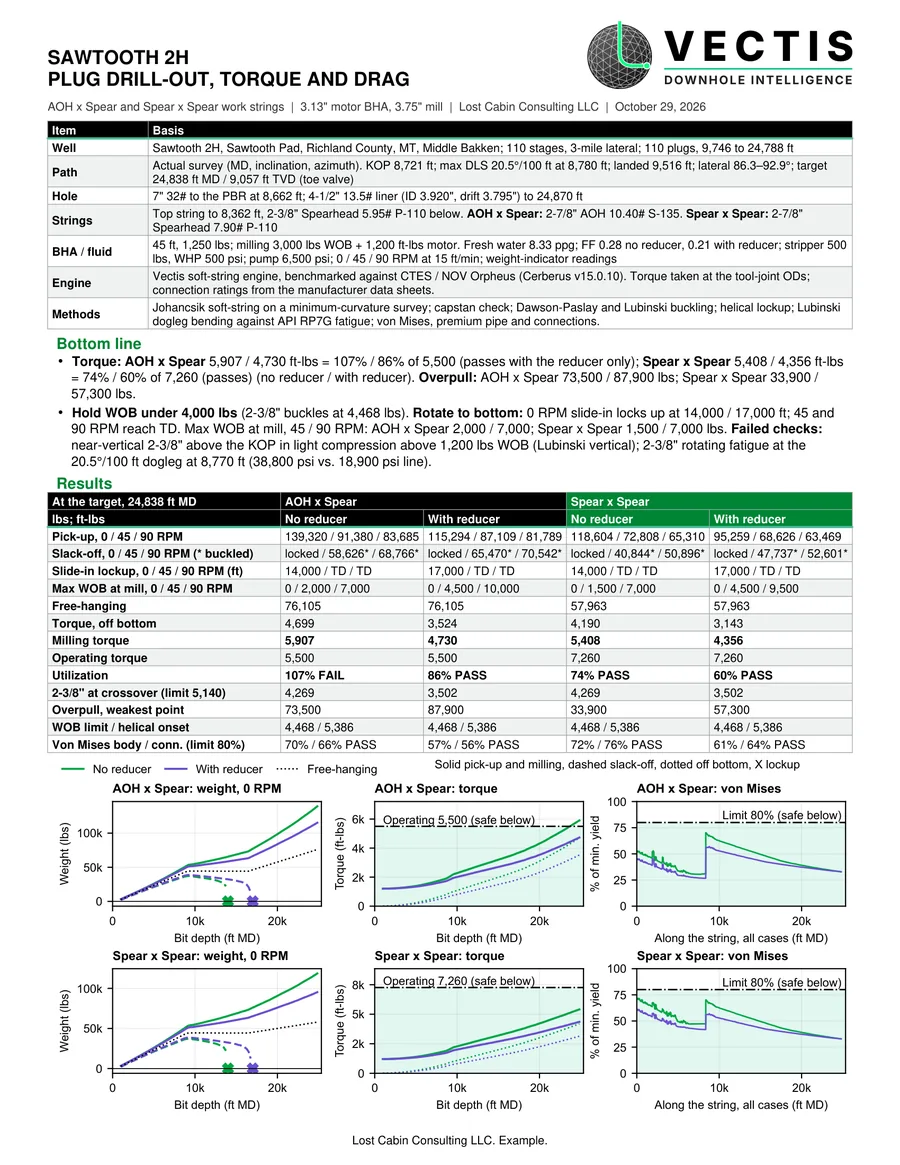
- One-page PDF per well, letter size. Basis, bottom line, results for both string designs with and without reducer, and hookload, torque and von Mises stress vs. depth charts with the safe operating zone shaded.
- Pad jobs: a roll-up summary page and the 3-D well paths for the pad.
- Interactive 3-D viewer: attached inside the PDF and opens in any web browser, offline. Rotate, zoom and pan the well paths, switch to plan or side views, color by TVD, dogleg severity or the torque and drag results, and hover for MD, TVD, inclination, azimuth and DLS.
- Layered wellbore and cement viewer when you send a CBL: one offline file you can email, with every string, the open hole and the cement bond in 3-D, and your wireline logs along the well.
- US oilfield units throughout (ft, lbs, ft-lbs, psi, ppg).
Example output
Example Vectis output.
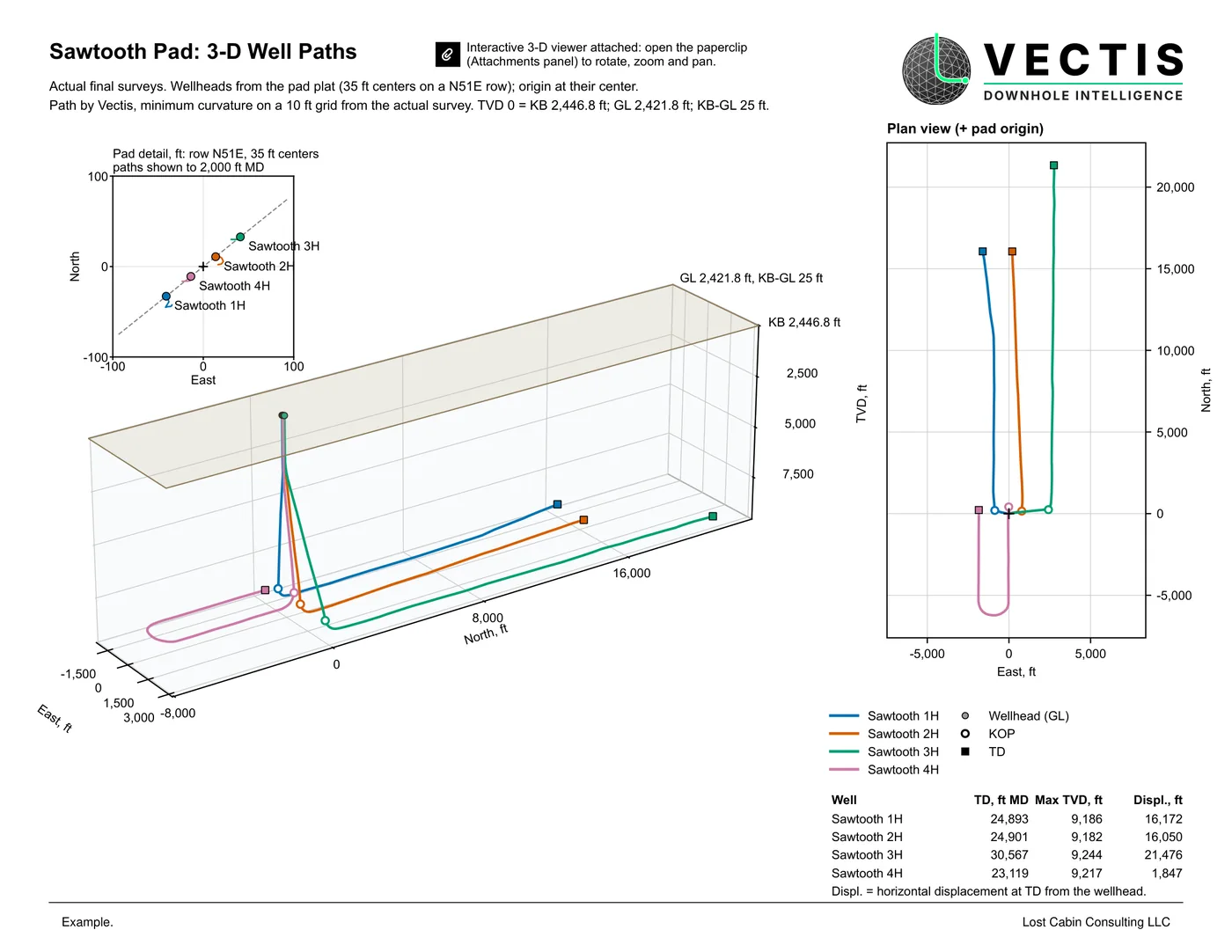
Interactive 3-D viewer
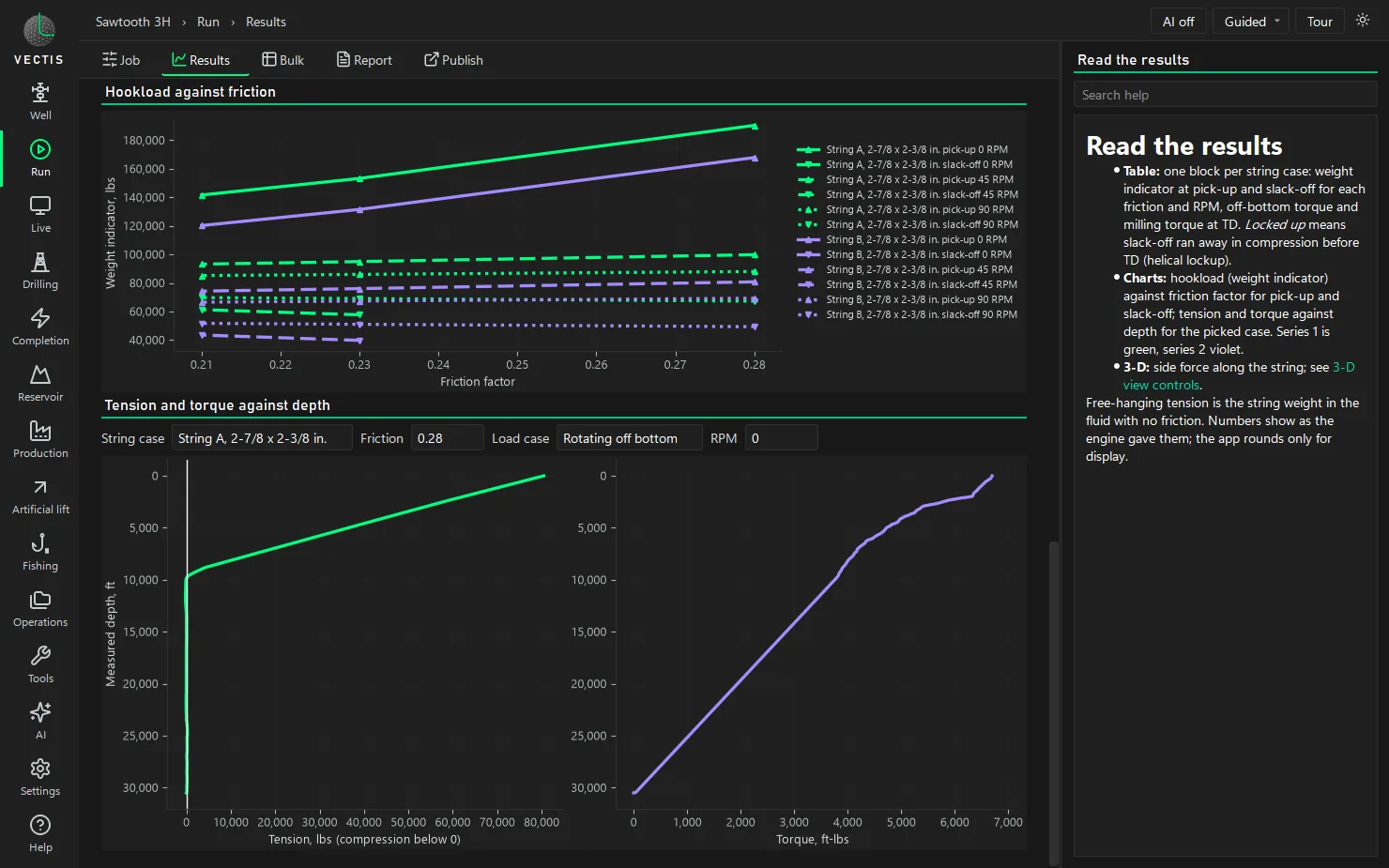
Every report now carries an interactive 3-D viewer. Turn the pad in any direction, zoom into the build section, look straight down for the plan view or edge-on for a section, and color the paths by TVD, dogleg severity or the torque and drag results. Hover anywhere on a path for MD, TVD, inclination, azimuth and DLS.
Sawtooth Pad. Example. Drag to rotate, scroll to zoom, right-drag to pan; Help: controls in the viewer explains the rest. About 7 MB; best on a computer or tablet.
Layered wellbore and cement viewer
For cement and completion work, Vectis builds the well in layers from the casing program and the cement bond log: open hole at bit size, the conductor, surface and intermediate casing and the liner, the cement behind each string colored by bond index, open channels on the side of the pipe where the log shows them, the liner-top PBR, packer and hanger, marker joints, perfs, toe valve, shoe and the planned frac plugs, plus a fracture layer simulated cluster by cluster from the pump schedule (created and propped length, oriented to the regional stress). Turn any layer on or off and make them see-through. Exaggerate the annulus so it shows at scale, zoom into any depth window, read the bond index down the well on the depth track, and slice a true-scale cross-section anywhere. Hover for MD, TVD, hole and casing sizes, cement status and bond index. What the log does not measure is labeled as an assumption.
Wireline and MWD logs load straight in from LAS, DLIS or CSV, with depths tied to the survey from the log header. With an open-hole caliper, the hole wall and the cement sheath follow the measured hole size and wash out where the hole did, colored by enlargement over bit size. A CBL amplitude or bond index curve colors the cement down the well. Pick gamma ray, density, neutron, resistivity, sonic or any other curve to color a ring around the hole and plot it on the depth track. Hover reads every curve at that depth.
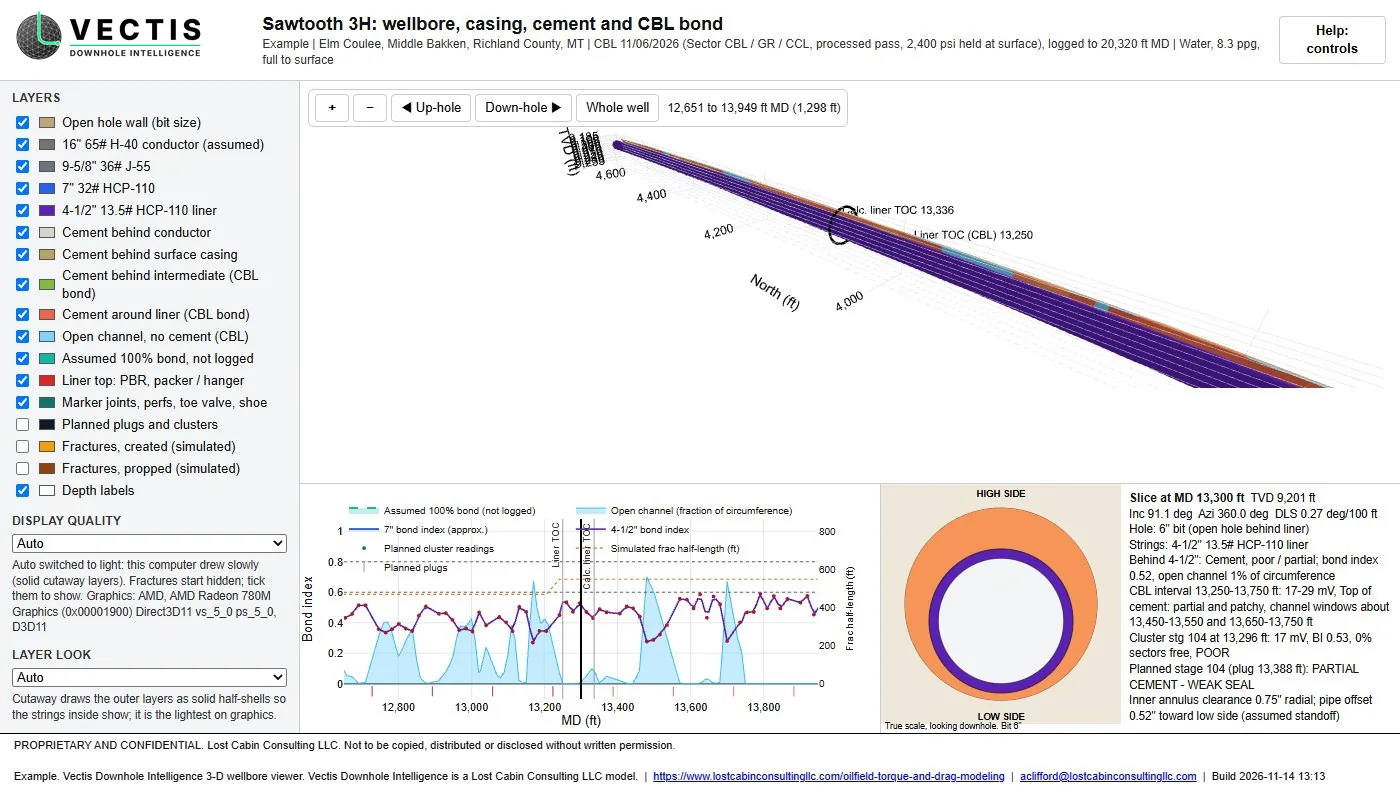
Sawtooth 3H, 4-mile lateral. Example. Press Help: controls in the viewer for every control. About 5 MB; best on a computer or tablet.
Questions
What does a torque and drag model cost?
Each job is quoted on request. Send the well files and the job type and we reply with a quote. Prices are not published.
What do you need from me?
The actual directional survey, the wellbore (casing and liner sizes, weights, IDs and depths), the work string, the BHA, the job, and the fluid and pressure. Friction factors from offset wells and any torque, set-down or overpull limits help if you have them. Send what you have; we ask only for what the files cannot supply.
What do I get back?
A one-page, letter-size PDF per well with the basis, the bottom line, results for two string designs with and without T&D reducer, and hookload, torque and von Mises stress vs. depth charts with the safe operating zone shaded. Pad jobs add a roll-up summary page and 3-D well paths for the pad.
What jobs can Vectis model?
Plug drill-outs, cleanouts, TCP gun runs, workover and completion strings, and tapered work strings.
What is Vectis Downhole Intelligence?
Vectis Downhole Intelligence is our own well engineering software suite, and torque and drag is one of its modules. The torque and drag engine is built on published industry methods (Johancsik soft-string, minimum-curvature survey on a 10 ft grid). It is benchmarked against industry-standard commercial software at about 3% on hookload and 0.3% on torque on a matched job.
Can I see the wells in 3-D?
Yes. Every report carries an interactive 3-D viewer as a PDF attachment. It opens in any web browser with no internet or software needed: rotate, zoom and pan the well paths, switch to plan or side views, and color them by depth, dogleg severity or the torque and drag results. A Help: controls button explains every control. Try the example on this page.
Can you show the casing and cement from a CBL in 3-D?
Yes. Send the cement bond log with the wellbore schematic and the survey, and Vectis builds a layered 3-D wellbore: open hole, every casing string and the liner, the cement behind each string colored by bond index, open channels, the liner-top packer and hanger and the other hardware, and the fractures simulated from the pump schedule. Zoom into any depth, exaggerate the annulus to see it at scale, and slice a true-scale cross-section anywhere. Anything the log does not measure is labeled as an assumption. It is one file that opens offline in any browser.
Can you put my wireline logs on the 3-D wellbore?
Yes. Send the logs as LAS, DLIS or CSV (a scanned PDF can be traced). The open-hole caliper sets the true hole size, so washouts and tight spots show in the hole wall and in the cement sheath. A CBL amplitude or bond index curve colors the cement down the well. Gamma ray, density, neutron, resistivity or sonic curves color a ring around the hole and plot on the depth track. Log depths are tied to the survey from the log header and any tie-in shift you give us.
Do you check combined stress, not just tension and torque?
Yes. Vectis runs von Mises equivalent stress at every 10 ft of the string in every load case, on worn (premium-class) pipe: tension, bending through the doglegs and from buckling, torsion, and pump pressure on the inside wall. Each connection gets a combined tension and torque check against its data sheet. Both are held to 80% of rating, and the report shows the result in the table and as stress vs. depth for each string design.
Can you model a well with only a plan survey?
Yes, if no actual survey exists. The report will say it was built on the plan survey.
Models are engineering estimates built from the data you send. See the disclaimer.
Request a model
Email your well files with the job type in the subject line, or reach Adam on LinkedIn. Quotes on request.